Last Updated: 11/11/2024
Name: Jaluku
Classification: Humanoid/Alternative
Homeworld: Unknown
Coloration: Tan
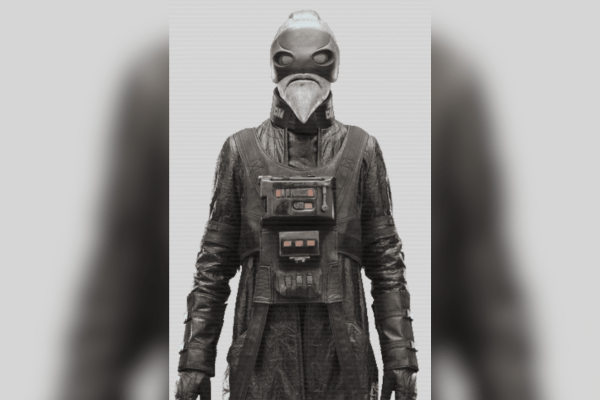
Biology: The Jaluku were a sentient species with a seemingly relatively Human-like frame from the neck down. This included possessing the same general frames and builds, being bipedal with two legs, two arms, and five-fingered hands, though they did seemingly stand around a head taller than the average Human, coming in at around 2 meters in height. Jaluku skin was smooth, despite having an almost coarse appearance, being pale tan in coloration, with mottled darker patches all over their bodies that almost gave off the appearance of being perpetually dirty.
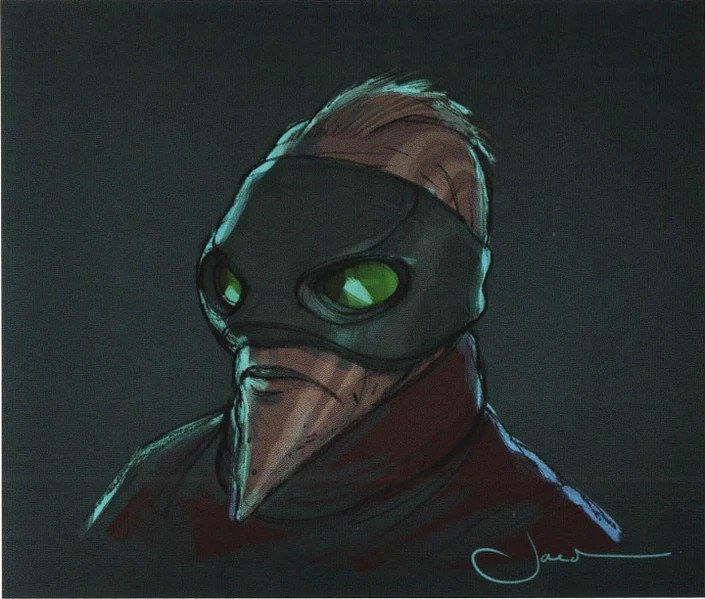
Jaluku had rounded, nearly hairless heads, described as being “radish-like,” with grooves extending around the backs of their craniums, as well as incredibly pointed chins, and a lone tuft of tan hair on the top of their heads, extending back in a long strip. They had wide mouths, and seemingly always donned unique masks that covered their eyes and presumably noses, though the purpose of these masks has currently gone unstated.
Lore: The Jaluku are a species we currently know little about, though we can at least say they had been introduced into the greater galaxy by the start of the Galactic Civil War. They generally wore thick clothing, and always had masks covering most of their faces, though it’s still unclear whether these were necessary for survival or simply something favored by the species for some unknown reason. From what we’ve seen so far, they may have had a propensity for certain criminal fields such as bounty hunting or mercenary work, though it’s still difficult to come to a concrete conclusion.
Continuity: The Jaluku were designed for Star Wars Canon, specifically for the film “Episode IX: The Rise of Skywalker” by one of my personal favorite concept artists, the talented Jake Lunt Davies!
Unexplored: Given that we currently know next to nothing about the Jaluku, we’ll remain relatively vague in this section, only asking mostly basic questions about the existence of this species. This includes ideas such as: What part of the galaxy do the Jaluku come from, what is the name of their homeworld, and what environment(s) does it boast to facilitate such an evolution? When were they first discovered, by whom, and were they ever members of any major galactic faction, government, group, etc.? Were they ever involved in any major events, wars, or eras? And what were the Jaluku probably most well known for?
Did any Jaluku individuals reach galactic acclaim for any sort of feat? Were there ever any Jaluku Jedi, Sith, or other Force wielding individuals, and what were their average natural midichlorian levels? On that note, did they have any other unique anatomical or biological traits we don’t know about, and what is the purpose of the masks? Was it true that it was common to find them filling criminal roles? And finally, what other sort of established general worldbuilding concepts did they have surrounding them, such as their history, architecture, art, developments, technologies, philosophies, religions, politics, societies, civilizations, governments, economies, exports, diets, languages, cultural practices, traditions, or habits?
Additional Notes: I absolutely love the Jaluku, one of my favorite designs to come from “The Rise of Skywalker,” and it’s been really neat to see their design recycled in media like the “Obi-Wan Kenobi” series so far (though there’s still a noticeable lack of them in non-live action projects at the moment). It was cool to hear about their inspiration and design history from people like JLD, and it was an especial treat when their name was revealed in the “Galaxy’s Edge” companion mobile app “Batuu Bounty Hunters” alongside a couple of the other species I’ve written about like the Kakala, the Wayuning, and the Rawanikola, a really special day for me as a species archivist, and I’m surprised it’s taken me this long to finally write their article!
Reference Images:



Leave a Reply