Last Updated: 04/06/2026
Name: Chagrian
Classification: Humanoid (Near-Human)/Alternative/Aquatic
Homeworld: Champala
Coloration: Blue
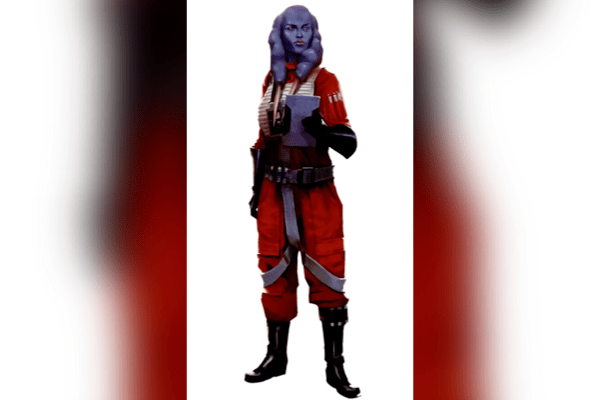
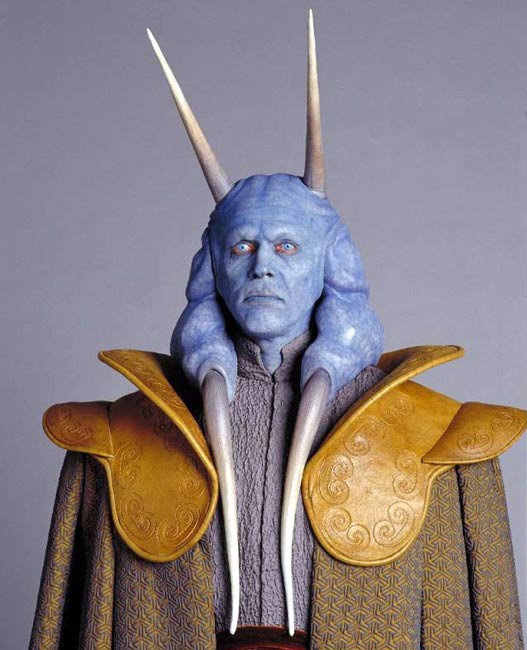
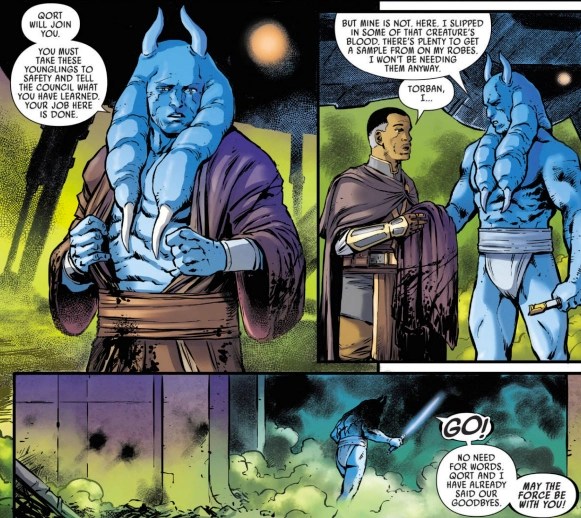
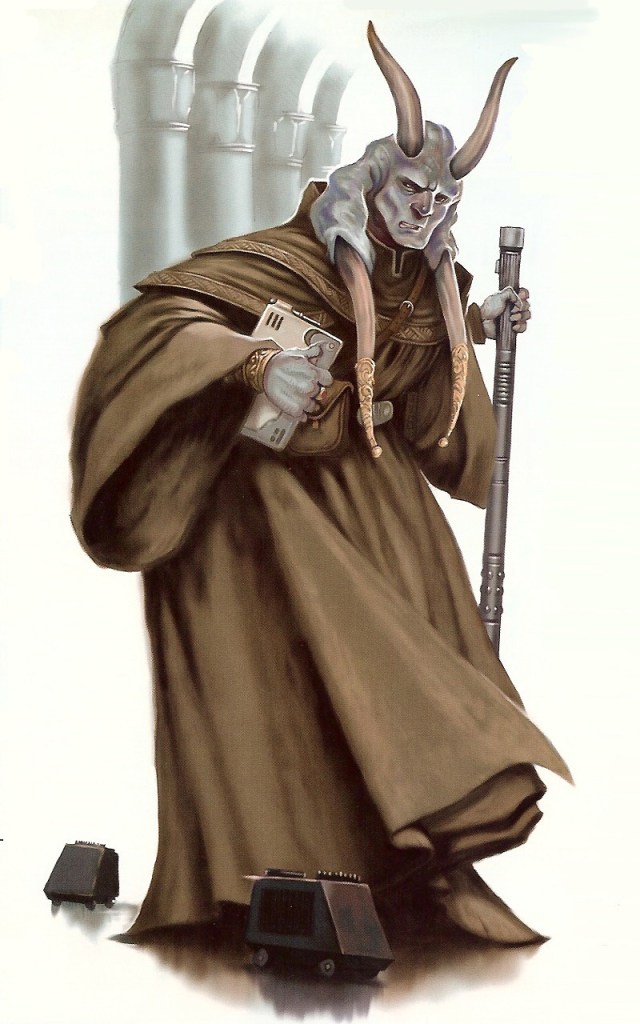
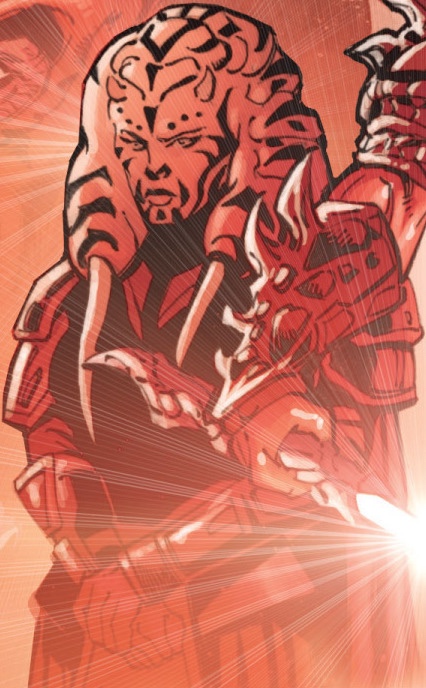
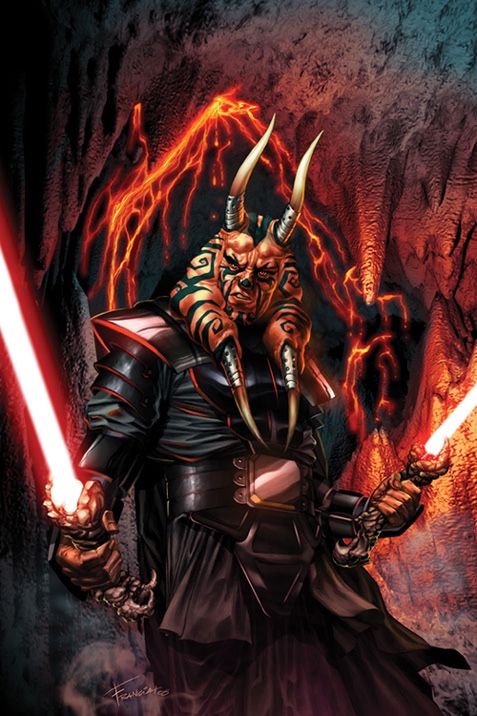
Biology: From the neck down, adult Chagrians were visually nearly identical to Humans, albeit, generally much more blue. From the neck up, however, they had heads featuring two to four long horns attached to fleshy, ribbed lobes not unlike lekku. These osseous-like extensions were known as “lethorns,” and the lower two were very soft and malleable, while the two protruding from the top of the head were instead very solid and sharp. Only males possessed the hard, upper lethorns (although female Chagrians have occasionally been shown to sport tiny upper lethorns within the Star Wars Expanded Universe).
Chagrians were actually born as large tadpoles, and had at least two or more siblings at birth. They were raised in small pools of water or tubs indoors by both parents, and developed all of their humanoid appendages over the course of the next three to five years. As adults, Chagrians possessed lungs that could filter water similarly to gills, and adult members of the species could live comfortably in or out of water. They were relatively strong swimmers, and their eyes allowed them to see in low or nearly no-light environments, making them perfectly suitable for deep sea diving or living.
Chagrians had unique tongues, which were usually black in coloration, forked, and generally lacked any form of traditional taste buds. Said lack of buds was attributed to elongated exposure to Champala’s oceans, and so it was believed Chagrians who were born into families which had lived off of Champala for many generations regained something of a sense of taste. Their fork tongues could be flickered out of their mouth when above water, similarly to that of a snake, giving them an acute sense of smell in addition to their already superb eyesight.
This species generally had no desire to eat, especially for pleasure, commonly attributed to their lack of taste, and they usually chose to instead create the perfect nutritional meal packets that would sustain them for long periods of time. These packets were considered to be incredibly healthy and efficient, although they were also said to have tasted disgusting to any non-Chagrian.
Chagrian bodies could resist or absorb most forms of radiation, allowing them to swim in even the most dangerous, irradiated waters. They generally had many of the same traits as Humans, including the same general body shape, stature, and lifespan, although because of how they were born, it was assumed that the species could not cross breed with any non-Chagrian species. As soon as their vocal chords had fully developed, they were seemingly capable of speaking their native language known as Chagri, as well as Galactic Basic without issue.
Lore: Most Chagrians valued peace and order above all else. They took the ideas of law and justice very seriously, and were often regarded as both too passive, as well as not being fully capable of “free thought” due to their conformist beliefs. Despite this, many Chagrians chose to become scholars, traveling the galaxy to learn everything the could. Because they valued peace, they generally did not have any desire to become warriors, or to learn any combat-related skills.
Citizens of Champala lived in what they described as a socialistic civilizations, the government supporting every individual as equally as possible. The planet itself was very wealthy, and most Chagrians took full advantage of their privileges. Even the “poor” Chagrians were considered rich by most galactic standards. Members of the species spent most of their spare time either inventing more sustenance rich food alternatives, or learning via waterproof books and stories told to them by offworld travelers.
Most cities on Champala were built near water, and were submerged only some of the time, due to the planet’s extreme tides. While the cities were above water, Chagrians would generally keep to themselves and remain in or near their homes. However, when the cities were underwater, they would utilize these times to swim from city to city, doing whatever tasks or errands needed to be done. Because of this, they rarely required landspeeders, planetary spaceships, or even the need to walk for long distances. Only high elevated cities would require “aircars” to access, and these are still rather new developments as of the “modern ages.”
Because the Chagrians valued peace so much, they attempted to stay as far away from war as possible. About 500 years prior to the Clone Wars, many Chagrians were enslaved by an unspecified group and distributed as underwater laborers. They chose not to fight back, and it was years before they were liberated and saw freedom once again. After these harsh experiences, many of Champala’s newly freed residents sought revenge and power, and some even going into the slaving business themselves. Most Chagrians, however, ascribe to the same planetary religion. They continually hoped and prayed that their god-king “Aram Acheron” would someday return to them, liberating them from whatever shackles they are bound by, and lead them to victory over all of their enemies once and for all.
During the Galactic Civil War, a large number of the Chagrian people eventually joined the Rebel Alliance as pilots, mechanics, information specialists, and even foot soldiers. They fought against the Galactic Empire until the war’s end (playing an especially major role in the fight for Dac/Mon Calamari due to their amphibious nature), and were one of the first species to join the Alliance of Free Planets/New Republic. It was said that only during times of war are they allowed to wear the holiest color in their religion, red. (Due to this, it was a known occurrence that Chagrians who embraced the Dark Side of the Force would dye or stain their skin a deep crimson color.)
Continuity: Nearly all information regarding the Chagrians’ culture and society have not yet been canonized, and there seems to be no present or pressing intention to do so. There are still only a handful of Canon Chagrians, the most popular being Mas Amedda, as well as the Jedi Master “Buckets of Blood” aka Torban Buck, and out of all of the information listed above, only their base anatomy and biological terms, as well as their homeworld, remain established.
Unexplored: Per usual, when a species’ history is relegated almost entirely within the EU, it is fully up for brand new exploration just as much as it is for accurate adaptation. This means we get to ask questions like: Are they still canonically born as tadpoles, which is a very unique take on an otherwise humanoid species, or are they birthed in a different fashion now? Their world of Champala definitely has not been explored, and even in Legends, it was still evolving with new technologies and cities, so what exactly does that look like, and what are the specifics of their environment, weather and tide patterns, and complex architecture and underwater pathways?
With the New Republic in Canon still barely been explored itself, can we say for sure that the Chagrians will be included among their roster, and how present were the Chagrians among the ranks of the Rebellion? The entirety of their history as slaves has been wiped clean, so is that something that should be established again? And are there any other unique traits, whether societal, traditional, historical, or even biological, that could and should be explained further that would help make the Chagrians more unique and memorable in an already crowded universe?
A society entirely made up of peace loving scholars has been used in Star Wars before, but it is still rare, especially for an amphibious species such as these. How do they preserve texts when underwater? How do they react to traveling to non-water based worlds to attend prestigious universities? If they are as rich and knowledgeable as is implied, then their architecture must be incredible, right? Again, what might their cities look like, whether illustrated, animated, or in live action? Even with regards to their strange religion, in which all we know about so far is really just their potential savior “Aram Acheron,” who is going to burst forth from Champala’s sacred “Logue Rock” and lead them to victory someday, where might this ide have originated? Did it come from some offworld traveler who wanted his own cult, or is Aram truly a powerful force deity, with elements of the prophecy all being rooted in truth? There is literally so much ground to explore when it comes to the Chagrians!
Additional Notes: Many people often mistake Chagrians for just being very blue Togruta, or sometimes even consider them to simply be a combination of Togruta and Nautolan based off of my own experience. However, they truly do have many interesting distinctions, both biologically and socio-economically, that I wish were more on the side of common knowledge. Also, despite being such a peaceful and wise species, nearly every major canonized Chagrian has seemingly been, for the most part, a violent and/or morally ambiguous individual, so that may be a lore tidbit that they are trying to leave behind. Regardless, I want to see so much more of this species, and they’re definitely on the easier side when it comes to adapting a species onto the big screen (tsk tsk Andor Season 2). Regardless of the source, I just want the Chagrians to get more of the love they deserve!
Reference Images:



Leave a comment