
Last Updated: 2/13/2024
Name: Karran
Humanoid: No
Classification: Beast (Rodent)
Homeworld: Karra
Coloration: Gray, Brown, or Black
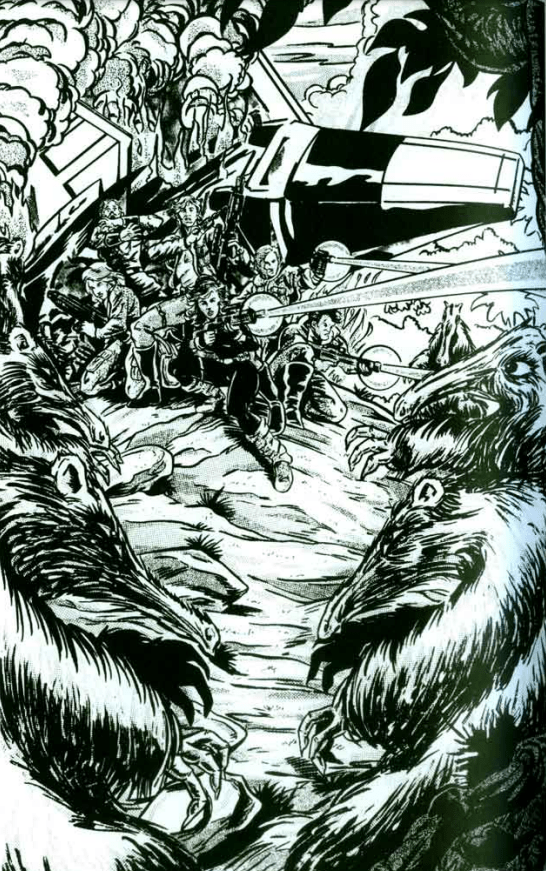
Biology: The Karrans were a race of massive sentient rats found almost exclusively on the planet Karra. They were generally quadrupedal, with large, muscular bodies, capable of standing almost 2.5 meters when sitting up on their hind legs. Karrans were covered in a scraggly layer of fur, often dark gray, black, or sometimes brown in coloration, although it thinned near each of their appendages and snout. Karrans had spindly hands and feet, each having four digits ending in sharp claws, although they noticeably lacked the presence of thumbs. They also had large stomachs and hunched backs, with elongated craniums.
They had long snouts and jaws, with large nostrils situated towards the end, alongside a wide mouth and curved lips. Their mouths were full of large, wide-set, gnarled teeth, as well as two enormous, sharpened incisors jutting from the front of their lower jaw, seemingly resting on the outsides of their lips when closed. Karrans possessed insectivorous diets, presumably using their long snouts to raid insect colonies, nests and hives. It is unclear what languages, if any, the Karrans were capable of pronouncing. We do, however, know they possessed some level of natural telepathy, capable of controlling swarms of insects with only their minds, and possessing some sort of shared, pseudo-hive-mind. Despite the shape of their mouths, Karrans could speak Galactic Basic Standard, albeit in an unusual dialect.
Lore: The Karrans were a little known sentient race who were still considered rather primitive as of their first documented discovery, seemingly around 500 BBY (although they actually recalled being briefly visited by friendly settlers centuries prior who taught them to speak Basic, although said settlers’ whereabouts are now unknown). That said, being an Outer Rim world, on the surface Karra sports little that would ever cause an offworlder to visit, being covered mostly in jungles, grasslands, and a plethora of semi-sentient insects. However, around half a millennia before the collapse of the Republic, it was reported that the world actually housed rich deposits of a valuable mineral known as “Varmigio,” a key component in the construction of functional hyperspace cores. This revelation led a mining corporation known as the “Mineral Assets Partnership” to quickly attempt to establish a claim on the world, setting up facilities in an attempt to gather the sweet, sweet Varmigio.
Unfortunately, the initial rumors were greatly exaggerated, and there was little to no ore found beneath the planet’s surface. While the “Partnership” had not found the Varmigio they were looking for, they did find a race of highly intelligent, giant rats, who had not taken too kindly to the sudden arrival of offworlders who were rapidly digging up their land. Utilizing their telepathic hive-mind, the Karrans took control of massive swarms of bugs, overrunning the new facilities and driving the corporation offworld, finding no reason to waste resources in retaliating as there was no wealth to be found on Karra. Still, the rumors would persist, and a little over 500 years later, the Galactic Empire would arrive, again seeking the false wealth promised to them via rumors. Establishing a small colony on Karra, they too were attacked and overwhelmed by hordes of insects controlled by the Karrans’ single shared conscious state, and like the miners, they too would be forced to withdraw for fear of utter ruination.
While rather unsettling in appearance, it doesn’t seem the Karrans were overly hostile, just protective of their local ecosystem and the food it provided them. By the time of their discovery they had developed basic wooden tools and other simple objects like clay containers, cloth pouches, and even crude mud structures, however, their lack of thumbs did limit how they interacted with various items and made it difficult for them to grasp things in traditional ways. Community also seemed incredibly important to the Karrans, and while they each retained some level of individuality, their hive-minded group-think was also very important to their way of life. When the Karrans felt their community was threatened, they were able to cast aside their own identities and function as one unit with complete synchronicity, which included manipulating the local wildlife to execute their collective will in droves. It is also believed they saw all non-Karrans, including offworlders, as a type of insect, treating them as swarms with hives and queens.
Karran themselves dwelled in villages consisting of a number of mud or clay structures infused with local grasses that helped them camouflage with their surroundings. These villages were circular in nature, with the central hut belonging to the group’s chief known as the “Headman.” Karran warriors would train often, shedding all their fears of injury and death, to protect themselves from the largest of the intelligent, predatory insects found on Karra whom they were incapable of controlling telepathically. They also spent much of their free time constructing tools, forming ornate pottery, and even playing a game known as “Soli” which involved participants throwing around three different balls, each varying in size and color, seemingly at the same time. Despite their recent progress, Karrans were still incapable of understanding or utilizing outside technologies, and were considered to only be in their “stone age.”
Continuity: The Karran have yet to be mentioned in any Canon source, and currently remain exclusive to an obscure corner of the EU.
Unexplored: Given their relatively short time of discovery, there are some limitations when it comes to the Karrans, although I can think of at least a few questions I’d like to see answered regarding their lore, and of course, in Canon absolutely nothing has been established or explored about them yet so they could be taken in an entirely different direction someday. As for my questions, we have to start with the following: When were the Karrans actually first discovered? And how long before that did they develop true sentience? On a planet apparently covered in giant insects, why did this lone rodent race come out on top? Was it difficult for them to survive, and what was the true scale of their population? How spread out were individual clans, and what was the distance of their telepathic links?
How did the Karrans’ interaction with those first known settlers go? Did they panic and attack these offworlders, hide in their disguised villages, or were their first meetings peaceful and fruitful? How long did it take for the species to learn Basic, what language did they speak prior, and were there any other things they also adopted from these offworlders? On that note, where did these people go? Are they still hidden somewhere on Karra, have they long since been eaten by the insect hordes, or did they leave once they realized this lush planet was not uninhabited? We have a pretty detailed account of the various invasions of Karra, but did the planet really have much Varmigio to boast? Did anyone else visit Karra before or after this 500 year span? And did the Empire ever return in retaliation, possibly deeming the world too dangerous to exist and subsequently glassing it from orbit? I think it’d be nice to see answers to some of these if the Karrans’ lore is adapted into Canon faithfully, and of course, there are also other general worldbuilding traits worth expanding upon as well!
Additional Notes: There’s some really fascinating stuff here, which is to be expected for a species from the time. In fact, while initially writing this article, I finally came across full free scans of the both sources the Karrans came from, the Star Wars Adventure Journal #1 and Alien Encounter sourcebooks from West End Games! It caused me to pivot the direction of the article a bit as there is much more info in them than is collected on sites like Wookieepedia (although I plan on updating the Karran Wook page soon as well, so it may not seem as much like it by the time you get around to reading this article). Still, I’m glad to be able to record this one, and while it would make sense that they’d never even be encountered in Canon, I still wouldn’t mind seeing them referenced or even appear in something soon!
Reference Images:
 Star Wars Fan Publications
Leave a comment