
Last Updated: 11/7/2023
Name: Pkorian
Humanoid: Yes
Classification: Near-Human
Homeworld: Pkori
Coloration: Red
Biology: Pkorians were a humanoid species occasionally found throughout the Star Wars galaxy. From what we’ve seen so far, they have tall, slender, Human-like frames with deep red pigmentation and brown or black hair. They had black lips and could possess light blue irises in their eyes. Internally they possessed a set of double hearts, alongside other presumably recognizable organs like a stomach and lungs. Pkorians also share a number of noticeable traits with another species, the Palliduvans, and were originally assumed to be one and the same until the distinction was clearly made. Both Palliduvans and Pkorians have hair growing only on the uppermost center portion of their head, as well as elongated, gangly fingers and pointed nails.
The biggest difference was the Pkorians solid red skin versus the Palliduvans solid white skin, although that had been chalked up to simply not knowing all the colors each species could be, with the solid non-Human-like pigmentation considered proof enough that they were the same. This being said, it is still very possible that the species are related, one potentially preceding the other, Zabrak style. It could also be a cousin species like the Aqualish and Harch, or a subspecies distinction like the Echani and the Thyrsian.
Regardless, Pkorians bore a lot of common traits with most sentient species in Star Wars. They had the capacity to speak and clearly pronounce Galactic Basic, although their native tongue, also called Pkorian, was considered much more difficult, requiring a strong tongue to create clicking noises and long rolling “R’s.” They also had a very similar diet to that of Humans, consuming various meats such as beef, veal, and poultry, dairy products like cheese and milk, and treats including cakes and alcoholic beverages, as well as less common delicacies like lizards and “Umbikki Stew.” It is also very possible that Pkorians had a natural aptitude for the Force and/or a high baseline midichlorian count, given that the only prominent instance we’ve explored so far was Force Sensitive. This is, however, only hinted at, as the species overall is simply stated to have naturally “heightened senses.”
Lore: Pkorians called the Wild Space planet of Pkori their home. Compared to most species, their population size was relatively small, with the entire race living in one single city on an isolated continent found on Pkori. Despite being refined to this lone settlement, the Pkorians thrived, their community happy and their environment abundant. Because Pkori was seldom explored or charted by the Republic or other extraplanetary factions, we know little of what the planet was like. The inhabited continent seems to have been covered in lush grasslands and forests, suitable for farming and livestock. The native Makani Trees offered versatility when it came to constructing tools and structures. And there appeared to be a great ocean some ways away from Pkorian civilization.
Community was very important to the Pkorians, and each member of society attempted to contribute in some way, shape, or form. Some farmers grew wheats and grains, while others raised the native Red Oxen, Cochukka Sheep, and a variety of birds, all for milk, eggs, labor, and/or butchery. Tailors created wonderful, flowy outfits, filled with color and detail. Jewelry makers designed ornate and elaborate pieces that were worn by most Pkorian women in social settings. Craftsmen and musicians helped throw massive celebrations for life events, and contributed to the evening communal festivities after long days of work.
Family was incredibly important among the Pkorians, with each one keeping detailed historical records that extended far back down the family trees, specifically detailing the women of each family as they found them to be consistent while the males among the families came and went. It is very possible that Pkorians were a polyamorous people, and there is currently no record of them practicing the tradition of marriage. Each family possessed their own library to store their familial records, with these libraries standing as a seeming symbol of a family’s pride and identity. Familial libraries were well crafted and ornate, being some of the most beautiful structures on Pkori. Their interiors were also described as smelling fragrant, as it was common to press flowers among their various archival books.
The Pkorians technically possessed neither a fully patriarchal or matriarchal society, instead being community led, however, they definitely leaned towards matriarchal, with various practices supporting this. Some level of gender roles seemed to have been loosely enforced among the Pkorians, with the men being assigned laborious tasks and dressing in fairly plain, but still colorful clothing, while the women performed more artistic or familial careers and were known for their embellished appearances. Femininity was embraced by the women of the settlement, with women usually wearing large, decorated dresses and elaborate, beaded jewelry. Some of this jewelry held cultural significance, such as a colorful set of arm bracelets, one worn by a woman for each year they had been alive, presumably gifted to them on their birthdays.
Male and female Pkorians did not cohabitate, with the women of each family living together in a singular dwelling while the men apparently each lived on their own. The women in these communes would all contribute to helping each other with their daily lives, and the elder-most Pkorian living among them was considered the head of that given family. They would help raise the young and keep the family records current. The birth of a Pkorian was a major deal among the entire community, and festivities were held to celebrate both mother and child each day a child was born. We know much less about Pkorian funerals, but given how much weight they placed on birth and death, especially for women, we can assume some large event happened each time there was a death in the settlement (whether that be mass mourning or large celebrations of life).
Given its relatively hidden nature among wildspace, outsiders rarely visited Pkori, although it did happen on occasion and the Pkorians were well aware that there was life outside of their planet. Interestingly, they paid little mind to the distinct species belonging to offworlders, and instead seemingly lumped them all together, believing there were only Pkorians and all those “from the stars” in the galaxy. Outsiders were more than welcomed on an individual level, although we know of no groups or corporations taking root on the planet, nor any attempt to trade or purchase Pkorian wares or export their quality produce into the greater galactic economic landscape. Pkorians possessed no innate desire to leave their homeworld, and found no value in traveling among the stars.
They were never made a part of the Galactic Republic and were never represented among any major intergalactic government. They were also not incredibly well known to the wider galaxy, and their language was only partially recorded, not popping up in every droid’s database. Pkorians saw outsiders as strange, often over-reliant on droids and technology. Pkorians did not hate technology, however, they never saw any need for it, and thus did not possess complex machinery, droids or computers, nor ships and vehicles. They also could not understand why offworlders wore tight fitting clothing or space suits, choosing to instead value comfort and breathability over any form of practical application.
The Pkorians had made contact with the Jedi Order sometime prior to the Clone Wars, and at least one youngling was given to them over the years. As far as we are aware, the Pkorians were never pulled into any major war as their homeworld never offered any sort of strategic, monetary, or resource based benefit, their people were too few in numbers to serve as a consistent slave force, and they were tucked just too far out of the way to be worth the trip. This is to their benefit, as they valued peace and almost never encountered any sort of conflict, especially of the violent kind. They possessed almost no weapons and no way to defend themselves from invaders, which is a reality they still may someday have to face.
Legends/Canon: While when considered the same as Palliduvans, their origins would have come from Legends, the distinctly new Pkorians are exclusive to Star Wars Canon.
Unexplored: There really isn’t a whole lot to cover here, as the Pkorians were fairly fleshed out after their first real appearance as an entire species, but are still lacking in consistent appearances, yet are also intended to be mysterious and uncharted. There are a few questions we can still seek answers for, including how far their origins go back and whether or not they are related to the Palliduvans. An offshoot of Palliduvans that settled on Pkori relatively recently could explain why there are so few of them located in only one area on the planet. However, that still leaves the question of how they have libraries full of Pkorian history and family trees.
If they have been there for a really long time, it’s possible they could have experienced some sort of major disaster in the distant past that set them back technologically (if they are indeed related to the Palliduvans) and sequestered them to just one area on one continent. This apocalyptic event could have potentially come from space, resulting in their subconscious lack of desire to ever travel among the stars, although that’s definitely starting to reach a bit. It’s also possible that other groups do, in fact, exist across the planet and given their lack of technology that would allow them to travel or communicate across vast distances, they simply aren’t aware of each other’s existence. If they are, in no way related to the Palliduvans and this is just a case of convergent evolution, then it’s possible they just have low birth rates, giving additional reason to their celebrations of childbirth.
This is probably the concept that I would like to see explored the most, although we also have other lore details and questions to consider. When did the Pkorians first make contact with the outside galaxy? How did that interaction go down? Has there ever been a push to incorporate them into the Republic Senate, which was either seen as low priority or was turned down by the Pkorians themselves? Have any armies or corporations attempted to make a move on the planet, and if so, why? Were they ever affected by any galactic events in past eras such as the Old or High Republic, or will they face trials in the future of the timeline? How often do they encounter offworlders, have they built any sort of spaceport, and do they ever receive any sort of imports or make trades with those they interact with?
Along that line, what do they think of those from among the stars? Is it just their clothes and reliance on technology that they find different or strange, or are there other details, habits, traits, philosophies, or aspects of their appearance that stand out to the Pkorians as being curious, strange, unsettling, or even taboo? What sort of philosophical or religious beliefs might the Pkorians hold, if any? What happens if a family’s history isn’t well documented or the records are destroyed? How does the transition of power happen with family elders? How and where do the men of the city live, and what is their societal role as compared to the women’s? And how did Pkorians commemorate death?
These are just a few specific questions that I would love to see be explored further in the future, and I could easily think up many more. It’s also good to just establish the baseline lore bits that I bring up in pretty much every article which include additional broad questions such as what does their civilizations and governmental system look like, how does their economy function, what sorts of distinct habits or traditions do they hold that might firmly set them apart from other species among the galaxy, what exactly might their language sound like, what sort of variety do we see among them in regards to their anatomy, pigmentation, biology, and potential dimorphism, and what does their music, art, jewelry, clothing, tools, and architecture sound and look like? Based off of their descriptions so far, this species is ripe for further exploration within a visual medium, whether that be a comic, video game, animated project, live action, or even just trading card art.
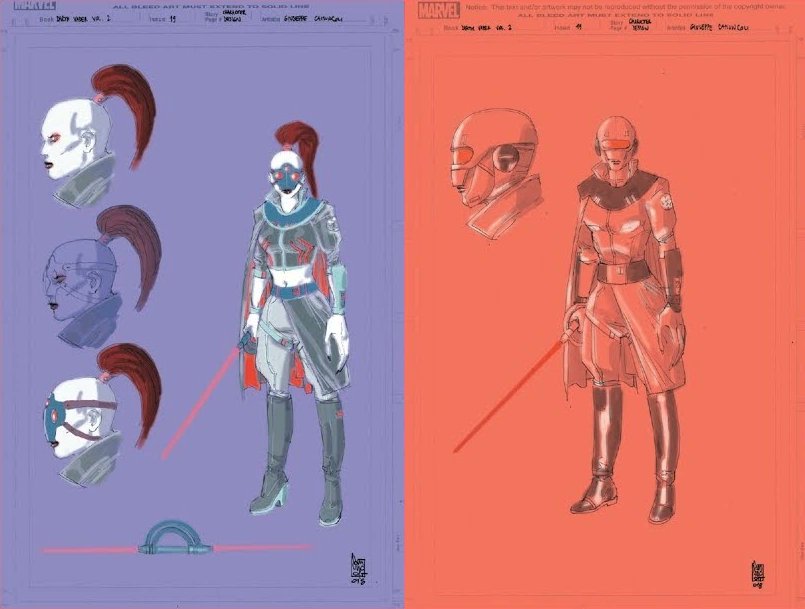
Additional Notes: I was definitely one of those people who assumed that Iskat Akaris, the Pkorian Inquisitor, was originally a Palliduvan when she first debuted, and there’s a major reason for this outside of just the similarities, so you can’t blame anyone for easily buying into the idea. Concept art revealed for Iskat’s design showed that her physical appearance was originally intended to be pretty much indistinguishable from Aurra Sing’s (she may have even been intended to BE Aurra SIng, given Aurra’s Jedi past and latent Force abilities). So clearly, Iskat started life as a Palliduvan, then various elements were changed and it was made more ambiguous, and then finally in the novel “Inquisitor: Rise of the Red Blade” gave us our first mention of the Pkorians and their specific lore. And honestly, while a bit confusing (and frustrating during the period of limbo), I ultimately don’t mind.
They didn’t just say Iskat was a Pkorian and leave it at that, they really fleshed out the species, separated them from what we know about the Palliduvans (and honestly may have given them even more lore than their predecessors currently have), and made the species feel alive and unique! I’m always down for this sort of change or update if there’s a reason for it, so I can get behind this. That means there are only a handful of Inquisitors whose species still have not been revealed yet, but we’ll have to save those for another time. Until then, I hope we see more of the Pkorians, but primarily just on their homeworld as per their established lore, and not just thrown into the galaxy all willy-nilly. In the end, consistency is the key!
Additional Images:


 Star Wars Fan Publications
Leave a comment