Last Updated: 12/18/2023
Name: Kitonak
Humanoid: Yes
Classification: Beast (Canine)/Alternative
Homeworld: Kirdo III
Coloration: Pink, Tan, or Brown
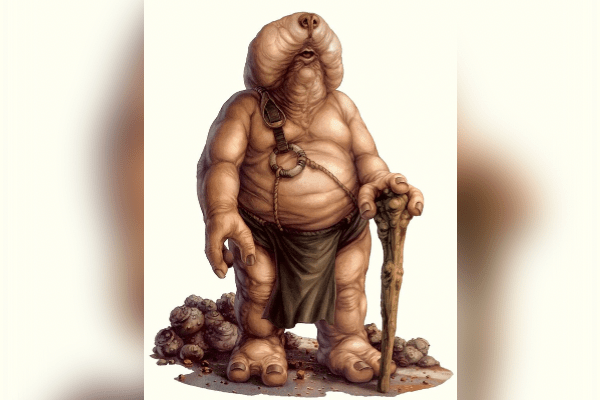
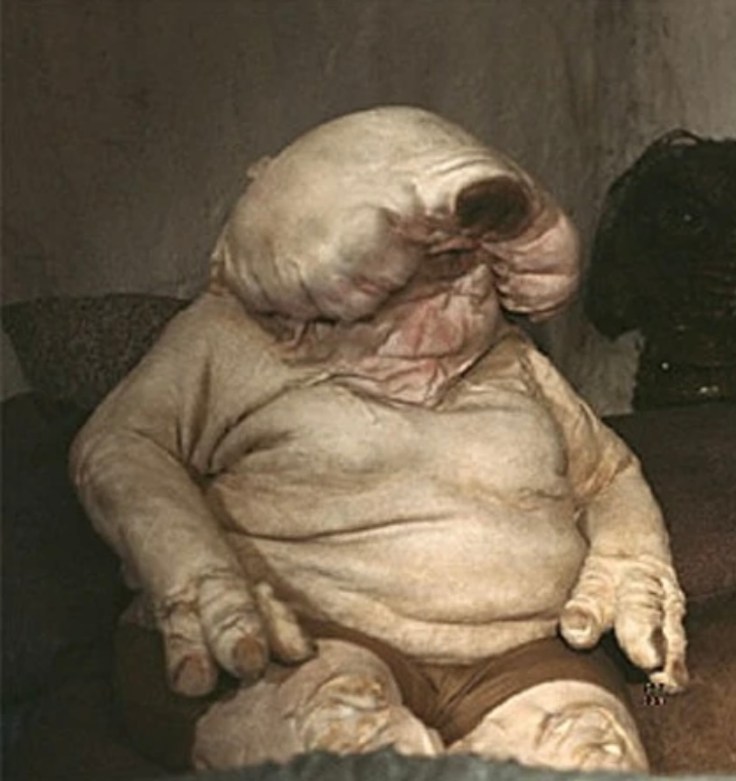
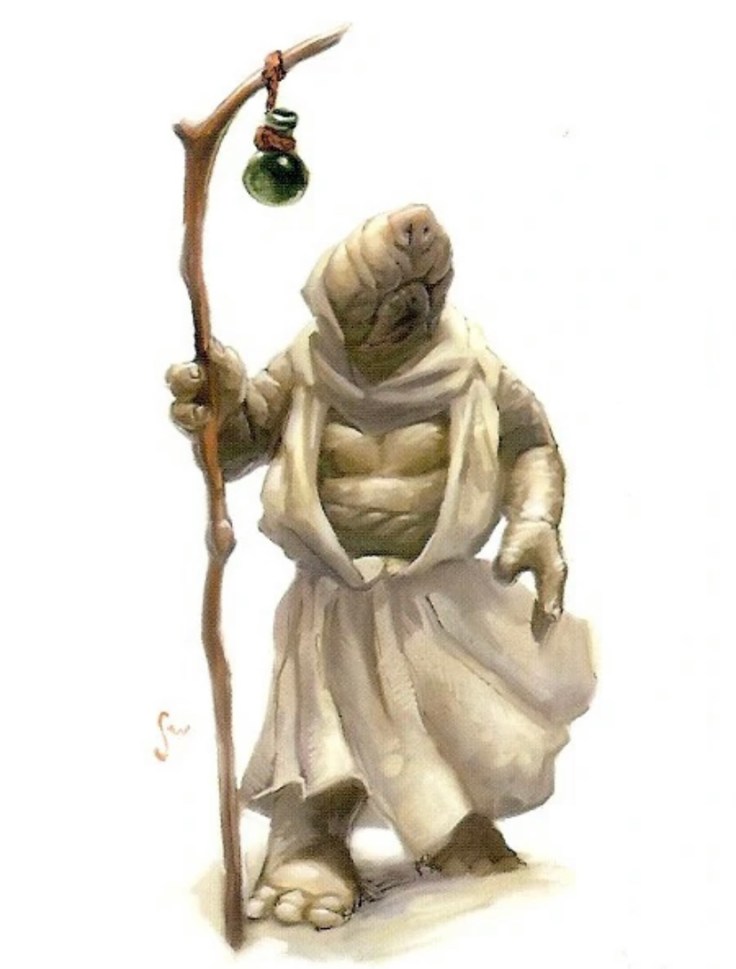
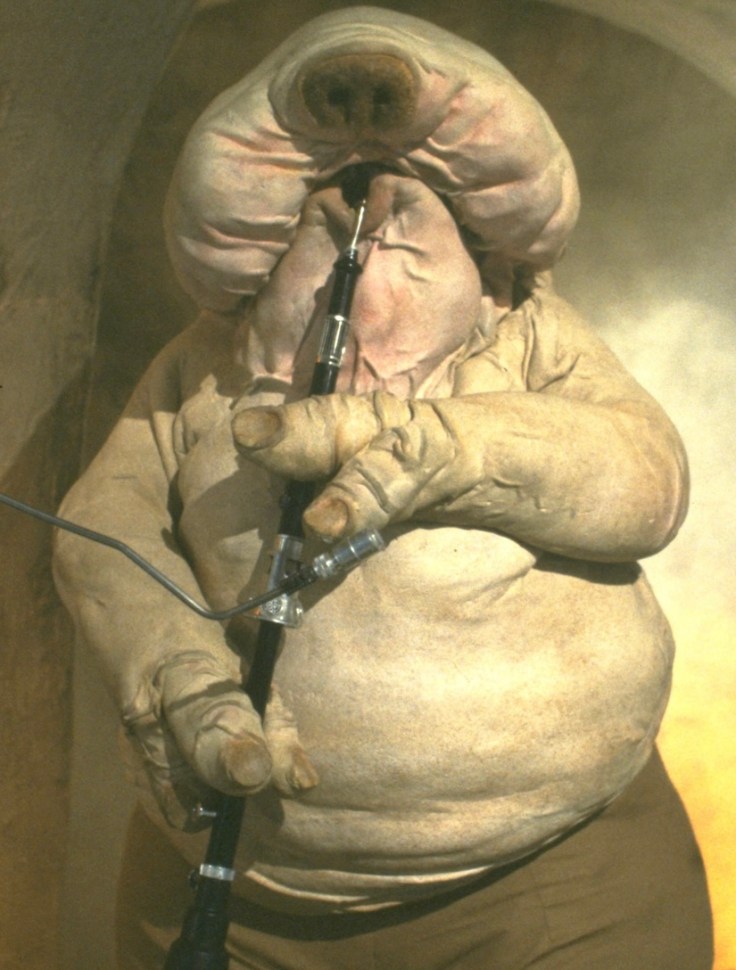
Biology: The Kitonaks were a bizarre canine species well adapted for desert environments. They varied widely in height, standing anywhere from 1 to 1.8 meters tall when fully grown, although they were often on the shorter side of that range. They were an incredibly heavy species, with plump bodies and an abundance of fat rolls. Their thick skin was pink or tan in coloration, covered in many wrinkles and veins, yet no hair, which was unusual for canine species. This leathery skin was very durable and hard to pierce, folding over the most vulnerable parts of the body to keep them extra protected from puncture wounds.
Their thick limbs were surprisingly muscular, giving them extraordinary strength, although they were known for being a very slow moving species due to their size. Their stubby legs ended in either two-toed or three-toed feet that were disproportionately large, although it’s unclear why the number of toes differs from Kitonak to Kitonak. Their arms also ended in three-fingered hands, each sporting large, pointed fingernails that were usually filed down. Despite how large they were, these hands were considered to be very flexible with great grip strength and quick moving fingers.
Kitonak heads were very large, split into a small portion underneath that a much larger, overlapping segment on top. Their small mouths were found on the lower portion of their head, while their large noses and tiny eyes were situated on the front of the large section. They were able to close their nose and hide their eyes and mouths, as well as cover the small ears on the back-sides of their heads, all to protect them from the treacherous sandstorms found on Kirdo III. Many Kitonaks spent much of their lives with their eyes closed, and those who didn’t suffered from poor eyesight problems, so they often had to rely on their other senses to help them move and navigate.
Their large bodies actually housed dozens of organs, often twice as many as the average Human or Human-like species. Some of these organs included four lungs, two hearts, and at least two stomachs. This helped them store up extra food and oxygen during times when they were unable to open any of their facial orifices. They were also great burrowers, allowing themselves to bury themselves in the sand before storms. Although if they were caught off guard, they could use unique muscles in their feet to anchor themselves to the ground, and even slide themselves forward in a “slither-like” motion without ever moving their legs or lifting their feet.
In addition, they had a great sense of smell. They had two separate sets of olfactory organs on their body, one linked to their nose which wasn’t always active, as well as a secondary set on their feet that they could use during any circumstance. Being a carnivorous species, most Kitonaks lived almost exclusively on a diet of “Choobas,” a slug species native to Kirdo III. Standing incredibly still, they tricked the nearly blind Choobas into thinking they were their own food source, the Sulfaro Plant, and once a Chooba had climbed into a Kitonak’s face, they would slurp them up and go on their way. Due to their unique metabolism, Kitonaks could survive on a single Chooba for about a month, although offworld they found it difficult to find alternative food sources.
Kitonaks also excreted a “musk” from special scent glands that was described smelling like vanilla, making Kitonaks surprisingly pleasant to be around for many species. Kitonaks had the capacity to be rather intelligent, although due to their often slow and carefree lifestyles, they rarely found a need to apply their knowledge or wit for anything worthwhile. Kitonaks who dwelt offworld usually exercised their minds much more often, and were thus very unassumingly clever. While it appears that some Kitonaks had the capacity to pronounce Galactic Basic, albeit incredibly slowly, more often than not they spoke exclusively in their native tongue of Kitonese, consisting primarily of low, slow rumbling noises.
They also aged incredibly quickly, considered physically, mentally, and sexually mature at around nine standard years old, although their average lifespan remains unknown. Their gestation period was approximately 10 years long, and young grew very slowly within their mother’s bodies. Much of the outside galaxy believed that they had a gestation period of only a few days due to their mating ritual known as the “Dance of Love” that took place each decade where they mated and had children over the span of about a week. However, this was nothing more than a misconception, and Kitonak mothers would actually give birth before being impregnated almost immediately, the child awaiting to be birthed until the next Dance of Love.
Lore: Despite their often “primitive” and nomadic lifestyles, the Kitonaks were actually an fairly ancient species, developing sentience sometime between 25,000 and 5,000 BBY. They were fairly well known by the end of the Old Republic era, and were potentially a part of the Galactic Republic although they were not seen in the Senate. Much of the galaxy discredited the Kitonaks due to their unassuming appearance, slow movements, and relaxed personalities, however, the Kitonaks were actually quite observant, intelligent, and philosophical. According to Imperial records, the Kitonak homeworld of Kirdo III was not discovered until a few decades before the fall of the Galactic Republic, however, it was closer to at least 4,000 years, so those records appear to be wrong.
On Kirdo III, the Kitonaks were broken up into large, nomadic tribes. They would slowly wander their planet’s vast deserts and settle down only for short periods of time. Due to the continual wind and sand storms, the Kitonaks owned few possessions. Anything that they could not carry on their belts would blow away, causing them to deem it as unnecessary. Instead of putting value in physical possessions, Kitonaks put value in concepts such as music or philosophy. They would spend much of their time thinking and being creative, and then share it with their fellow tribesmen.
Kitonaks were also most well known for their patience and empathy, with the natives of Kirdo III never engaging in war or any violent behavior. They seldom experienced frustration, and preferred for things to go as slow or last as long as possible to ensure quality, complete understanding, and overall satisfaction. It was customary for Kitonaks to carry a variety of instruments, and gather at night to put on wonderful concerts. Every night before they went to bed, they would engage in a ritual known as the “Telling of the Story” as well. The adults of the community would craft an elaborate tale rooted in both fiction and non-fiction, which would evolve each night as new plots, elements, characters, and twists were added. These stories would help teach the young Kitonaks morals as well as just patience in general.
It wasn’t incredibly common for two Kitonak tribes to cross paths, but when they did they would gather to celebrate and share stories and philosophies with each other. Each tribe knew of the existence of others, and considered themselves to be a democracy despite not having any sort of formally established governmental structure. Instead, they designated certain members of their tribes to serve as messengers, and when issues arose, these messengers would track down other tribes to share the news, issue warnings, or even conduct votes, although this process lasted so long that by the time the messenger returned, the issue was almost always long forgotten.
It was also customary for Kitonaks to make a decision when they reached the age of nine years old. If they thought their tribe was too big or did not require their existence, then they would set out into the desert on their own in search of a new community. Often, this came in the form of randomly encountering a smaller tribe, although they sometimes discovered spaceports where they would then travel offworld to start a new life among the stars. Outside of a handful of spaceports, however, almost no outsiders willingly traveled to Kirdo III. Given how the galaxy perceived both the harsh planet as well as the slow and reserved people, and due to the planet offering nothing in the way of unique exports or other features, Kirdo III was never on anyone’s list of planets to visit.
Interestingly, the planet did not have any large natural predators, and so the only threats Kitonaks faced were starvation, quicksand, and flying rocks during turbulent windstorms. Fortunately, the Chooba population was large, and so they rarely risked going hungry. They were also able to bury themselves under the ground during rockstorms. Although there was almost no way for them to avoid the planet’s quicksand, and once a Kitonak was stuck, they would usually wait still for weeks until they could be rescued or they would simply sink into the sandy depths and die.
Kirdo III had a rather unique weather cycle caused by unknown means. The planet was dry and windy, without rain for 10 years at a time. However, once a decade massive rain clouds would suddenly engulf the planet and fill all of the dried out lakes and riverbeds. This decennial event had come to be known as the “Great Celebration of Life.” Once all the basins and rivers had filled, the Kitonak would start a special ceremony known as the “Dance of Love” where they would go down into the water to mate and deliver their newborns. The details surrounding this event had seldom been observed or documented by offworlders. Single Kitonaks would also woo mates using their musical capabilities leading up to this ritual.
The Kitonaks were generally a very religious species, which resulted in all of their unique rituals and philosophies. They worshiped a deity known as the “Cosmic Egg,” which was also revered among the Nediji species of Nedij, although why both species which never had any contact had identical figures of worship was never revealed. They would ponder many questions about the nature of the Cosmic Egg, and would often give it their thanks and praise. Kitonaks were also irrationally afraid of caves, believing they were all gates to the cursed underworld where the Cosmic Egg had no jurisdiction. Supposedly any Kitonak who entered a cave on Kirdo III never came back out, however, the validity of these claims was never reinforced.
If Kitonaks left Kirdo III, they would commonly take up residence on similar desert worlds such as Tatooine or Jakku. Those who spread out across the galaxy often took jobs as musicians, writers, or storytellers due to their upbringings. Others would become spies and informants due to their ability to remain incredibly still and look unassuming. Many people would assume Kitonaks were sleeping or dormant, and disregard them as a potential leak for sensitive information, allowing the Kitonaks to hear all sorts of secrets that they could relay to their employers. Most of these spies worked for criminal organizations, although at least a few informants sided with the Rebellion.
It was uncommon for Kitonaks who were born of Kirdo III to completely shed their traditions or religious beliefs, and they usually made pilgrimages back to their homeworld for the “Great Celebration of Life” to mate and/or give birth. However, it was common for Kitonaks out among the galaxy to adopt new names. The general Kitonak naming convention consisted of four to six letter single names, with no family or tribe names. But often they would take standardized names such as “Thaddeeus Marien” or “Droopy McCool,” especially if they become authors or performers.
Following the Old Republic era, it became apparent that Kitonaks made for fairly reliable slave labor. Slavers would travel to Kirdo III and abduct young Kitonaks who would go off on their own to practice their music at night. Since it was a fairly common practice, the Kitonak slave trade began to become quite lucrative. Since Kitonaks did not fight back, they were notoriously compliant, although they were also notoriously slow. While some became slave labor, most became slave entertainers, putting their muscial talents to use, and often infuriating their owners with how slow they were. The Galactic Empire actually coined the nickname “Yazbo” for the Kitonaks, although it used as an offensive slur to make fun of how slow and incompetent they could be.
Overall, the galaxy’s reception to the Kitonak was rather negative. Many individuals found the fact that they moved and spoke so slowly to be incredibly irritating. It also annoyed many that, no matter what they did, Kitonaks would never grow upset, offended, or frustrated. Kitonaks believed in accommodating everyone, even those who were mean to them or did them harm. This meant that they were often taken advantage of, and they usually had very few non-Kitonak friends, as it took extreme patience to communicate with them. Still, some achieved moderate success within the galactic entertainment industry, and the Kitonaks faces and names were recognized across every corner of the galaxy.
Legends/Canon: The Kitonaks originated in “Star Wars Episode VI: Return of the Jedi,” with essentially all of the lore above being added later in Legends media. Within the confines of Star Wars Canon we know very little about the Kitonaks, although an abbreviated version of their Legends biology at the very least has been confirmed thus far.
Unexplored: As you can tell, there is very little about the Kitonaks that wasn’t explored within Star Wars Legends. Of course, all new lore can be created within Star Wars Canon should the creators decide to take the Kitonaks in a different direction. However, should their lore be adapted to Canon relatively intact, here are a couple of questions to ask that would help further flesh them out. First and foremost, what does the surface of Kirdo III look like? What are the weather patterns like? And just how harsh are these wind storms?
What is the secret behind the Cosmic Egg? Was it simply established by a spherical spaceship and offworlders who visited both Kirdo III and Nedij long ago? Or is it some real, yet to be discovered galactic entity? What was the Kitonak population count like, and how many Kitonaks are found on Kirdo III as opposed to out among the galaxy? Were the Kitonaks ever freed from bondage and allowed to join groups like the Rebellion or Kanjikulb? And did they ever hold seats on senates belonging to the Republic, Empire, New Republic etc.? What other rituals and religious beliefs did they hold? And was it possible to upset a Kitonak or make them violent outside of trying to force them to go into a cave? There are still a lot of small, even nuanced and philosophical ideas left to be explored regarding this species, and we can only hope that maybe answers will be revealed someday should any of their Legends lore remain Canonically intact!
Additional Notes: How can you not love Droopy McCool and the Kitonaks. They’re one of those species that are so ugly they become cute. I NEED to see more of them in Canon media, especially with how far both animatronics and animation have come. While they have a lot of limitations as a species for authors when creating a Kitonak character, they more than make up for it with their unique biology, beliefs, appearance, and more! So maybe consider including a Kitonak in whatever fan project you’re working on next, just to highlight all of their fun traits and quirks. I can’t wait to see how they’re utilized!
Additional Images:
 Star Wars Fan Publications
Leave a comment