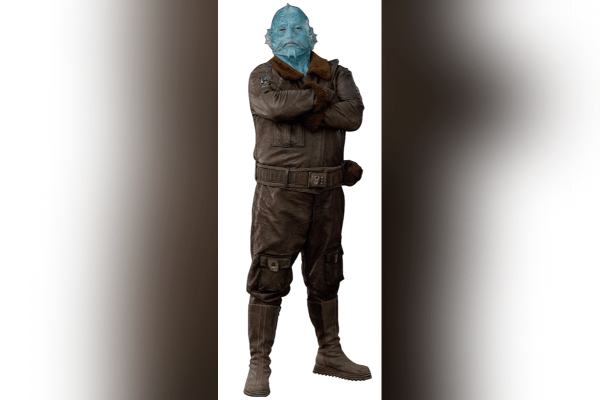
Last Updated: 11/29/2023
Name: Mythrol
Humanoid: Yes
Classification: Near-Human/Amphibious
Homeworld: Unknown
Coloration: Blue
Biology: Mythrol may appear fairly humanoid, but there biology is very different from the average Human. Throughout their life, Mythrol go through 3 developmental stages. When they are young, they are considered to be “pre-fledglings.” Pre-fledgling Mythrol produce a very sweet and aromatic natural musk from their bodies. They also begin to develop gills, although they do not have any fins or spikes on their face at this point After only a few years, the Mythrol would molt all of their old skin and become “fledglings.” Fledglings consisted of the youth, teenagers, and young adults of the species. During this stage, they would fully develop gills as well as larger fins on their faces. They would also lose their constant aromatic element to their musk and gain an internal thorax which contained their bowels and other internal organs. Their musk glands still existed, and visible, musty clouds could be excreted from around their neck when a fledgling Mythrol was startled or afriad.
As they became middle aged, Mythrol would molt yet again, losing the larger fins on their face and gaining more barbs and various patterns of coloration. This stage was considered to be the “post-fledglings,” which is when Mythrol were usually considered to be mentally mature and incredible swimmers. It is unclear whether they could still release their musky fumes, although cavities on the sides of their heads seemed to indicate that they may have gained greater control over their release. The arrangement of facial fins and barbs varied from individual to individual, as well as facial coloration when they were in their post-fledgling stages. So far, this unique coloration has been observed as red stripes located on the face.
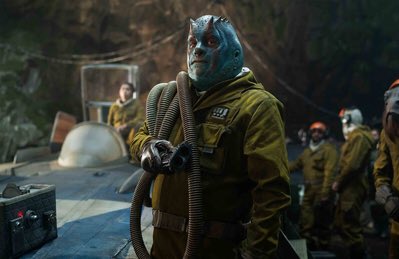
Overall, adult Mythrol averaged about 1.5 to 1.8 meters tall. They had a blue skin that helped them blend in with watery environments. Their appendages contained some webbing for underwater use, and their gills were found on their necks under their ears (although they still had fully formed and functioning noses as well). Mythrol did not actually have an extruding ear, only possessing a large aural cavity. While Mythrol could live and breathe outside of water, a certain level of moisture needed to be maintained around their bodies, and so it was usually rare to see them without a full body moisture-retention suit at all times. Drying out clearly brought them great discomfort, but we do not know if it was enough to kill them as it did not actually impede their ability to breathe. It’s also been revealed that the species could live for at least 200 years. Finally, like most humanoids, they had the capacity to speak and properly pronounce Galactic Basic.
Lore: Not much is known about Mythrol society. They had been discovered and integrated into the galaxy by the time of the High Republic, although they had made no noteworthy impact even by the time of the Clone Wars, and from what we know, they only popped up rarely during the Galactic Civil War. Some did, however, ally themselves with the Resistance during their fight against the First Order. Despite all of this, they seemed particularly acclimated to the galaxy outside of their currently unidentified homeworld, adopting Basic as their standard language and even going so far as to practice galactic holidays like Life Day.
Legends/Canon: Only a handful of Mythrol have currently appeared in Star Wars, all within the current Canon.
Unexplored: The majority of the Mythrol anatomy and biology has been explored surprisingly in-depth, while everything about their history, culture, and homeworld has not. This is what needs to be laid out before anything else can really be developed. Exploring what they did during the Clone Wars, why they are so acclimated to galactic culture, what on their homeworld constituted for their strange evolution and lifecycles, and how does their society, civilization, government, and culture (if any still remains) function as a whole will also make them much more memorable (although the Mandalorian has already done quite a solid job so far at keeping the species recognizable). This would also be the appropriate time to explore some of the other worldbuilding concepts I usually reference in my articles, broad ones that just help to flesh out the species and make them feel alive and dynamic; traits like their origins, discovery, alliances, philosophies, religions, habits, diets, advancements, traditions, and more!
Additional Notes: There is potential here for an interesting species or character here, although there are still dozens of far more interesting amphibious creatures. If you’re looking for a character who had a lot of knowledge about the galaxy but not a lot of experience, then maybe it’s worth a shot to add a Mythrol character into your story or fan work! (Also, why do they continue to refuse to give the Mythrol from The Mandalorian a name???)
Additional Images:

 Star Wars Fan Publications
Leave a comment