Last Updated: 12/5/2023
Name: Echani (Thyrsian)
Humanoid: Yes
Classification: Near-Human
Homeworld: Eshan
Coloration: White, Tan, or Gray
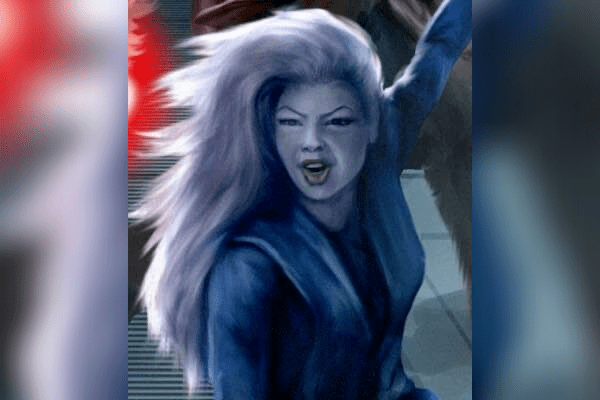
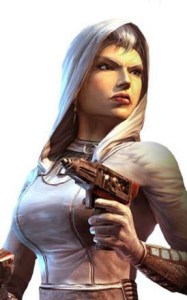
Biology: The Echani were nearly identical to humans, sharing the same internal biology, general features, reproductive organs, height, lifespan, etc. The only major differences were mainly in coloration. The Echani’s skin was usually a solid white, light gray, or a very light tan color that could pass for a very pale or albino human. Their hair was also always white or silver, and their eyes were similarly just as silver. Echani were usually very similar in appearance, with family members almost always appearing as identical to each other. Echani were naturally astute, athletic, and very lean, with their physical prowess and agility sometimes being mistaken for Force Sensitivity.
There was good evidence to suggest that they were an artificial species created by Arkanian geneticists who were toying around with human genomes some time ago, although neither species has ever confirmed or denied these speculations. This would most likely make them a failed version of the superior “Arkanian Offshoot” species, which is backed up by their strong resemblance to Humans, Arkanians, and Offshoots. There was also a much less common subspecies of the Echani known as the Thyrsians. Their skin was a much darker gray, and their hair was oftentimes black. They didn’t share the trait with the mainline Echani where they all looked identical, and were very distinguishable from each other.
Lore: Echani culture was rooted in combat and martial arts. They were a solely matriarchal society, answering to the greatest Echani female warriors and priestesses who made up the “Echani Command.” From birth, their combat-centered traditions were ingrained in the young, All Echani were warriors, and bonds/romances were born from fighting one another. They believed that to truly know someone, you had to meet them in the heat of battle. Minimal verbal communication was paired with intense martial arts, and birth intense forms of self-expression valued by the Echani people. They could even determine a person’s story and emotions just by dueling with them, which was how they learned to either respect or defeat their enemies. Their official language was Basic, but they were known for being rather quiet and observant, valuing physical communication over oral.
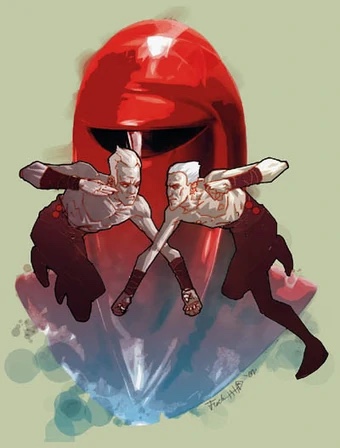
The unique Echani martial art form, also known as Echani, was akin to something like Teräs Käsi. It was not only practiced, but lived as a lifestyle and religion. It prioritized speed, movement, agility, and non-reliance on tools, weapons, or armor. They chastised those who used heavy protection, only wearing minimal clothing, sometimes light armor, and brandishing light fast weapons like blades or, very rarely, small blaster pistols. For some time energy shields were also popular and acceptable for their combat style, but they eventually became obsolete. They also had a much more artistic form of fighting known as Echani Firedancing, which combined their martial arts with exotic, ritual weapons. Echani Firedancers usually only applied their fluid skills to performances and not actual combat. Echani combat eventually became popular offworld, even being adopted as one of the official combat forms learned by the Imperial Royal Guards.
The Echani are an ancient species, existing long before the High Republic. As previously mentioned, they were most likely failed Arkanian experiment, although they had long since evolved past that and away from their Arkanian creators. While they lived primitive lives, they had developed advanced technologies like space faring vessels, eventually colonizing five other planets around their original homeworld of Eshan. These planets, including Bengali and Thyrsus, became known as the “Six Sisters.” The Six Sisters confederacy fell under the jurisdiction of the “Echani Command,” but also developed their own slight variations on the Echani traditions.
The Echani stayed to their own system, most likely because they didn’t possess hyperdrive technology, and were first introduced to the outside galaxy during the peak of the Old Republic. While they did not formally join the Republic, they didn’t treat them with hostility either. In fact, they began to export their unique weapons to the rest of the galaxy. Many galactic blades and Vibro weapons were actually inspired by traditional Echani designs, and Cortosis could also be found among the Six Sisters, making their blades incredibly valuable, durable, and great anti-lightsaber weaponry. Because of their skills, some groups like the Maktites saw them as a threat, but stood no chance when they attempted to invade.
On one of their worlds, Thyrsus, the Thyrsian subspecies arose and quickly took prominence. They were considered to be direct opposites of the baseline Echani, being a much darker gray in appearance, brandishing pikes instead of blades, and being patriarchal in nature (they also adopted “Thyrsian” as their official language, instead of Basic).They opposed the traditional rule of the Echani Command, although they themselves were equally as traditional and religious, and along with fellow planet Bengali they began the Bengali uprising. A massive civil war broke out between the Thyrsians and the Echani, with both sides losing many great warriors. After almost a century of conflict, Bengali was finally reclaimed by the Echani Command. However, the conflict on Thyrsus would last much longer, eventually leading to the Pact of Almera only a few hundred years before the Clone Wars where Thyrsus gained their independence and the hostilities finally ceased, at least for the most part.
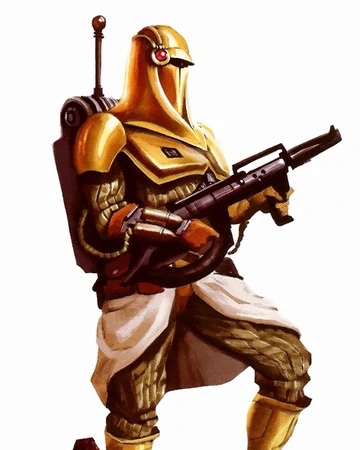
Being very religious and male oriented, the Thyrsians were spurred on by their most prominent cult known as the Sun Guard, a large sect of secret Sith worshippers. The Sun Guard, sometimes referred to simply as the Thyrsian Special Forces would then go on to declare war on the Mandalorians. They had somewhat similar ideologies and became fierce adversaries, however, the Mandalorians would usually come out victorious in the long term. Their most famous conflict was the Battle of Sintheti, or Battle for the Horned Throne, where the two races were employed by opposing royalty to fight on their behalf for claim to the Horned Throne. This battle would last for over three years with no real discernable outcome.
By 50 B.B.Y. the Echani had diminished in size and influence, mostly keeping to themselves while a few deviants went out and became mercenaries. The same could not be said for the Thyrsians, although the majority of the Sun Guard had disbanded. The remaining cultists discovered Darth Plagueis and swore fealty to him, believing him to be the fulfillment of their prophecy of the “son of suns.” However, when he was murdered, they changed their allegiance to Darth Sidious, despite his initial disregard for their skills. He did eventually use some of them as sentries or guards, until Palpatine commanded Dooku to send Ventress to assassinate all of them.
Many of the less radical Sun Guards became mercenaries and pirates, however, most had returned to Thyrsus by the rise of the Empire. A minority of the Thyrsians opposed the rise of the Empire and believed they had been fooled by the Sith, hoping to revive the original Sun Guard before they had become so diluted. Most Thyrsians supported the Empire, however, and were actually allowed to join its ranks because they were so similar to humans. Many of the Force Sensitive Thyrsians (as a well as a few Echani) even became Palpatine’s elite Shadow Guards, as well as Royal Guard instructors. After the fall of the Empire, however, their population was dwindling and, like the Echani, they became isolationists, refusing to participate in any more galactic events, especially regarding the New Republic.
Legends/Canon: The Echani (martial art and species) are currently only Canon in name, with none of their lore, especially not about the Arkanians, existing at the moment. At the very least where they were first mentioned canonically was within The High Republic, meaning there’s an even higher likelihood that they’ll see some form of fleshing out relatively soon!
Unexplored: The first question is, are the Echani and their martial arts the same in Canon as they are in Legends, or do they have a completely different culture in Canon? Of course, a lot of their history would have to be changed regardless because it conflicts with now-established Canon lore. Still, their martial arts could be better explored visually in canonically so we know exactly how they move and apply their combat style to their lifestyle.
Still, a couple questions that could still be expanded on within ant given continuity include: Did their society revolve around Cortosis, which planets was it found on, and what was the Echani mining industry like? What was their first interactions with non-Echani like? How exactly did the Thyrsians come to be? And were the Echani and Thyrsians truly products of Arkanian science, or was that simply a perpetuated myth? If they were Canon, how would they interact with eras like the High Republic or Age of Resistance, and would the Thyrsians believe that their “son of suns” would be Vader, Kylo, Snoke, Maul, or even the revived Palpatine? And how powerful would a full fledged Echani Force user with all of their training be, whether Jedi, Sith, or even an independent warrior?
Additional Notes: I actually really enjoyed where they took this species, especially the differences between the dominant species and subspecies. There are some genuinely interesting stories that can be told from the perspective of an Echani or a Thyrsian. Especially the gritty details of the Bengali Uprising or the Battle of Sintheti. Of course, now that most of this falls under the moniker of “Legends,” it can really go in any direction, as long as it’s an interesting one that really fleshes out this awesome species and makes them ever more interesting upon revisit.
Additional Images:
 Star Wars Fan Publications
Leave a comment