Last Updated: 02/13/2026
Name: Karkarodon
Classification: Amphibious
Homeworld: Karkaris
Coloration: White, Gray, Blue, Tan, or Brown
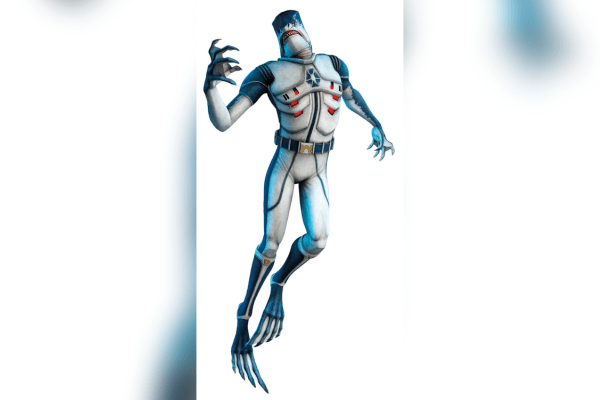
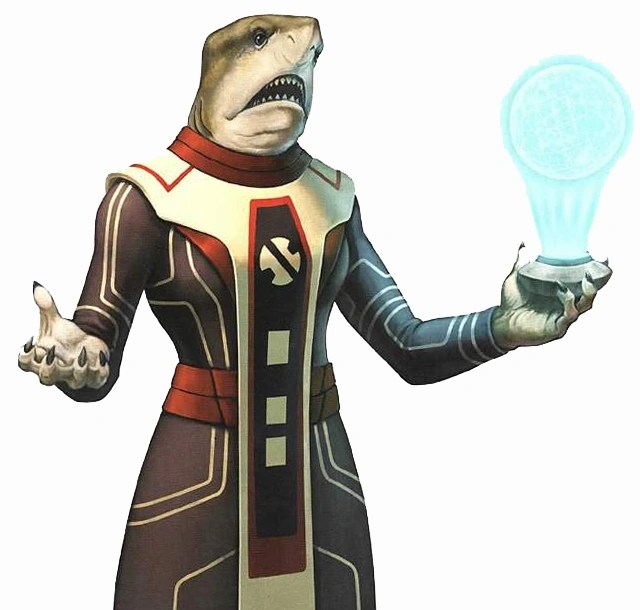
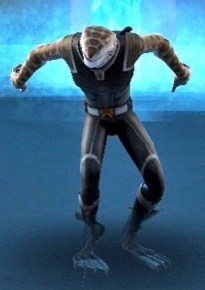
Biology: Karkarodon were shark-like sentient humanoids hailing from the oceanic world of Karkaris. They had light colored abdomens and faces, often tan or white, while their backs, arms, and legs could be one of a number of much darker colors, with a variety of mottled spots and lines giving each a different design and appearance. The differences in appearances apparently depended on what underwater biome the species developed in, as different environments required different forms of camouflage. Karkarodon were carnivorous predators, relying on a strict diet of meats, and they often had no qualms about consuming other sentient species, dead or alive.
While usually living below the surface, Karkarodon had the ability to breath above water as well, although it was not necessarily comfortable for them. They were also much more mobile underwater, moving slower and extra clumsily when on dry land. They had four-toed feet and large five-fingered hands, both sporting webbing and long, sharp claws. Because of their upbringing, they were generally muscular, and it was rare to see one that was either overtly skinny, nor overweight. They also seemed to have double jointed knees, and could swivel their legs to the side to form what looked like one long, vertical caudal fin which could propel them at incredibly speeds underwater.
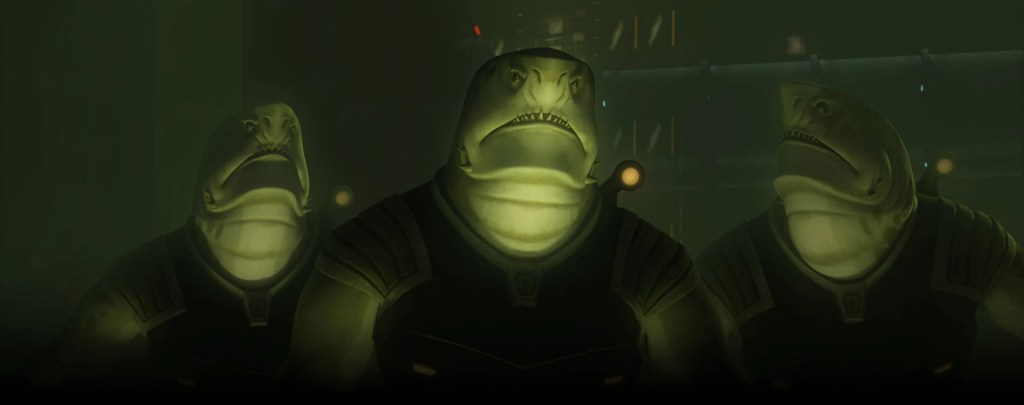
The Karkarodon’s head resembled that of a great either a great white shark (or sometimes bull shark, often depending on their individual coloration), and some of them even had spikes protruding from their necks. Most Karkarodon sported two sets of gills, one row on their neck and another under their nose, which also featured closable nostrils only used for breathing above water. Their heads were very angular, and their eyes were set on opposite sides of their head, limiting their field of view, especially when they were above the surface. Their mouths were lined with multiple rows of sharp, jagged teeth, and their jaws could unhinge to open into an incredible gape. Their senses of smell and sight were enhanced tenfold underwater, and despite being raised completely away from the surface, they seemed to have adopted Galactic Basic as their primary tongue, which they had the capacity to speak flawlessly.
Lore: The Karkarodon hailed from the Outer Rim watery world of Karkaris, situated in a rather unsavory part of the galaxy near planets like Florrum, Cantonica, and Felucia, and often overshadowed by another nearby watery world, Dac (also known as Mon Calamari). It was said to be a colorful world full of life, although the Karkarodon themselves chose to construct their civilizations among the murky depths of deep sea crevices, utilizing the canyons’ undercurrents to travel quickly between cities. They also took advantage of undersea volcanic vents which fueled their many industrial geothermal factories. To deal with their various offworld clients, spaceports were constructed on Karkaris’ few miniscule landmasses, which quickly became unkempt and heavily polluted, an issue that had quickly begun to threaten the many surrounding diverse reef ecosystems and even the deeper Karkarodon municipalities.
For quite some time, the Karkarodon were members of the Galactic Republic and represented by fairly influential senators on the Republic Senate, although, the species had a whole had little interest in politics or the state of the outside galaxy, and their senators actually held little sway among their own people. At the start of the Clone Wars, the Karkarodon’s home sector was usurped by the Confederacy of Independent Systems, to which Karkaris responded by declaring themselves completely neutral. The Karkarodon were known for developing complex underwater cybernetic weapons utilizing the native fauna of their homeworld, which seemingly fueled their economy, and this allowed a small contingent of CIS-allied Karkarodon to contribute to the Separatists’ war effort via unique weaponry, a handful of Karkarodon foot soldiers, and at least one prolific general.
One of the most infamous of these cybernetic animals were the massive jellyfish-like “Hydroid Medusas,” which were utilized during the tragic Battle of Mon Cala. Karkarodon General Riff Tamson led the Separatist forces during this conflict, although he would perish right at the end of the fight. Still, by this point, the Karkarodon had made themselves enemies of the Republic, and a number were either capture and detained on Coruscant, or executed altogether, the latter seeming to be the preferable option given their brutal, merciless nature and methods. Still, at least until the Galactic Empire came into power, the Karkarodon would have consistent run-ins with the Jedi, although following the collapse of the Order, it was much more common to just see them scattered out among the galaxy, often living uncomfortably on much drier worlds than their own.
Continuity: Karkarodon existed in Legends, but nothing has really changed since their jump into the current Canon (made by default given their only EU-era appearances were relegated to the “The Clone Wars” animated series).
Unexplored: The Karkarodon really don’t have that many appearances so far, so a lot of the lore we’ve been given is a bit bare bones. Still, there’s a truly fascinating framework here, and I think, with a little prodding, we could have some truly great worldbuilding here. So the following are a few questions exploring concepts we’ve already been introduced to that, if answered, will definitely help us better understand and subsequently write about this great species! So first and possibly most importantly, when were the Karkarodon initially discovered by the outside galaxy, when did this first come about given their deep sea existence, and how long were they members of the Republic? What level of influence did they have over galactic events, and had they ever been pulled into any major issues or conflicts, or did their rather nonchalant attitude help them avoid intergalactic drama?
What caused so many of their kind to ally themselves with the CIS, and were they represented on the Parliament or simply public backers like other members of the Separatist Council? What was the name (or names) of the manufacturing corporation(s) that developed the various cybernetic technologies and weaponized animals that they produced deep among the volcanic forges? What did the Karkarodon think of the various sentient inhabitants of Dac, and were they jealous of their overwhelming success and popularity, or had the two worlds remained amicable or completely uninvolved? Did the Karkarodon suffer at the hands of the Galactic Empire given their offenses during the previous war? And was their world ever cleaned up to prevent otherwise inevitable ecological disasters, or was it brought to ruin due to pollution, their manipulation of the local wildlife, suppression of volcanic vents, etc., causing them to spread out to other less damaged worlds? The answers to these inquiries, as well as the exploration of the list of more general worldbuilding traits which we normally discuss, will prove extra beneficial in the long run!
Additional Notes: As you will see, or may already have seen, I think any species aligned with the Confederacy of Independent Systems are some of the most interesting aliens to ever grace the Star Wars universe, as they each have distinct and interesting reasons for joining, have a wide and diverse variety of character designs, and the companies, corporations, or industries they represent are equally as fascinating and complex. The Karkarodon are definitely no exception to that, and I absolutely adore this species’ backstory and design. Yes, it may just look kind of like a generic shark (Carcharodon is literally just the scientific name for the Great White Shark), but sometimes that level and mixture of cheese and genuine ingenuity is what makes Star Wars so special and memorable. For quite some time, I also thought “Hydroid Medusa” was the name of their cybernetic manufacturing company and not the actual war beasts they produced, so if you read this article back when I had made those claims, I sincerely apologize for the confusion. Still, there’s some great stuff here, and I definitely encourage you to include a Karkarodon in your next project!
Reference Images:


 Star Wars Fan Publications
Leave a comment